


It's the topic that comes up in every conversation as soon as anyone talks about tuning an M3 F80, an M4 F82 or an M2 Competition. The crank hub. Some people get paranoid about it, others brush it aside, saying it's an internet myth. The reality is more nuanced, and above all it's measurable: we supply tuners, we see the engines stripped down, and we know what breaks. Here's what that feedback tells us, and how to secure this point without embarking on a €4,000 job.
The S55 crank hub: a design held by friction
The crank hub connects the crankshaft to the timing system. On the S55, BMW didn't opt for a one-piece part but for a multi-part assembly: the original sprocket and its two so-called "free" pulleys, pressed together by a Belleville washer.
The only thing holding this whole assembly together is the friction generated by the clamping force of the crankshaft bolt. There's no key, no pin, no positive mechanical connection. The part only holds because it's pressed together hard.
In standard road use, it works. BMW didn't design a faulty part; it designed a part sized for a precise specification. The problem appears when you go beyond that specification.

Why the crank hub slips
A friction connection has a limit: beyond a certain amount of transmitted torque, it slips. Three situations push the S55 towards that limit.
- Aggressive standing starts generate sudden torque spikes directly at the crank hub. These are shocks, not a gradual build-up.
- Tuned engines simply exceed the torque values the original design was built for.
- Track use keeps the engine at high revs for extended periods, which mechanically increases the risk.
When slipping occurs, the timing between the crankshaft and the camshafts is lost. The consequences range from a nuisance to a disaster:
- Engine warning light and fault codes
- Rough running, misfires
- Complete engine failure if the valves come into contact with the pistons
And here's the painful part: once the crank hub has slipped, there's no going back without stripping the front of the engine. In the most severe cases, it's a full rebuild.
Does it affect stock cars too?
Yes, there are cases on strictly stock vehicles. But you need to look at the proportions rather than the anecdotes. In the feedback from the professionals we supply, the vast majority of failures involve engines with at least a Stage 1. Stock engines account for a tiny share of the failures observed.
The practical conclusion is simple: if your car is strictly stock and stays on the road, the risk exists but remains low. As soon as you add power or drive on track, you enter the zone where the issue needs to be dealt with.
What we found on a customer's M4: proof that the reinforcement works
This is the most telling case we've documented, because it shows the mechanism in action rather than in theory.
A customer brings in his M4, alerted by a noise. Nothing dramatic at this stage, no safe mode, no failure. Just a noise that wasn't there before. The car was fitted with the MMX pulley reinforcement kit.
On disassembly, here's what we see:
- Completely deformed washers. They absorbed considerable stress.
- Bolts bottomed out in the slots. The assembly did try to turn, and it was stopped by the retaining system.
- Bolt threads that left imprints in the metal under the stress. The force involved was real.
- Visible bonding areas proving that the crankshaft bolt's clamping pressure was still intact at the time of disassembly.

This last point is the most important. The clamping pressure was still good, and yet the assembly tried to move. That's exactly the scenario the OEM design can't handle: friction alone was no longer enough, and without the kit, this M4's crank hub would have slipped.
Some claim these reinforcement systems are useless. We have the stripped-down parts that say otherwise. This engine was saved by a part that cost a fraction of the price of a rebuild.
The MMX pulley reinforcement kit: what it actually does
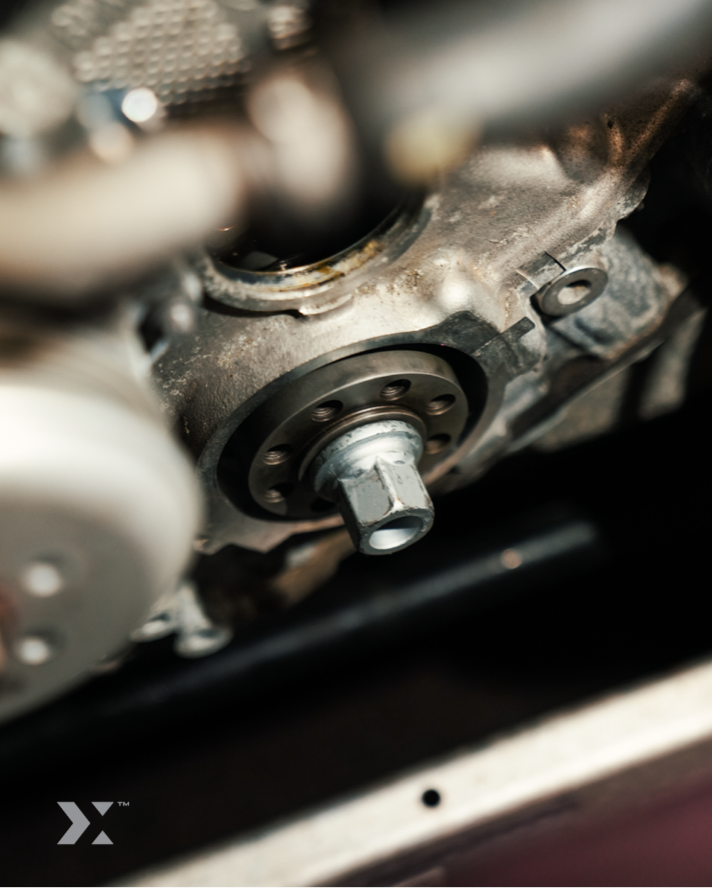
The principle is mechanical and direct. The kit locks the crankshaft pulley bolt in place and stops it from turning, using a system of retaining bolts. It adds a positive restraint where the original design relied on friction alone.
It's not a feel-good gadget, nor is it a half-measure. It's a targeted response to the most common failure mechanism. The M4 case above proves it: the system did exactly the job it was designed for, and it left visible traces of that work.
Its real selling points:
- Fitted without major disassembly. No chain removal, no timing reset, no drilling of the crankshaft.
- A cost in a different league from the one-piece option. We're talking a different order of magnitude, which completely changes the decision.
- Reversible and checkable. Taking it apart lets you see whether the system has been working, as on the customer's M4.
- Suitable for the vast majority of cases. A Stage 1 to Stage 2 car, used on the road with a few track days, is exactly the target.

So what about the one-piece sprocket?
The one-piece crankshaft sprocket exists, we offer it, and we need to be honest about what it is: an answer to a different use, not a "better MMX kit".
The principle is to replace the whole assembly with a one-piece part in treated, hardened steel, combined with pinning to secure it. This physically eliminates any possibility of relative movement between the pulley and the crankshaft. On the most extreme builds, the securing plate can be added on top.
It's permanent. It's also a major job:
- Drilling the crankshaft nose, with all the technique and precision that involves
- Removing the timing chain and fully re-timing
- The car off the road for a long time
- A budget of €3,500 to €4,500 depending on the workshop
At this level of work, it only makes sense to combine jobs: we recommend doing it at the same time as replacing the chain, chain guides and bearings. Otherwise you pay for the disassembly twice.
Which solution for which use
The criterion isn't "how much do you want to spend", it's "what do you do with the car".
- Stock car, road use: the risk is low. The MMX kit remains sensible insurance if you plan to keep the car for a long time, but there's no rush.
- Stage 1 / GTS map, road use + a few trackdays: the MMX kit is the proportionate answer. It's the most common case and the one where the risk avoided / investment ratio is best.
- Serious tuning, regular track use: the MMX kit remains relevant in the short term, but the one-piece sprocket becomes the medium-term goal. Plan it for the next major job.
- Engine being rebuilt or chain due for replacement: the one-piece, without hesitation. The engine is already open, and the extra cost is marginal compared with the disassembly alone.
Fitting: what we have in place
We sell the parts, but we don't leave our customers looking for a workshop at random. The crank hub isn't a part you fit by improvising, especially the one-piece version, where drilling the crankshaft nose leaves no room for approximation.
We work with a network of partner tuners and garages who know how to work on the S55. Depending on your region and the chosen solution, we'll point you to the right workshop. It's also thanks to this network that we gather the real-world feedback behind this article.
Do you really need to deal with it?
Just as M3 E46s once needed their floor welded, an S55 that hasn't been made reliable will put buyers off at resale. Beyond residual value, it's above all a sword of Damocles with every hard acceleration.
The maths is simple. The cost of a reinforcement kit is in no way comparable to that of an engine rebuild, and it's far lower than the depreciation a tuned car will suffer if its crank hub has never been dealt with. It's not a performance expense, it's a peace-of-mind expense.
Taking action
If your S55 is tuned or regularly sees the track, the MMX pulley reinforcement kit is the logical starting point. We'll then put you in touch with a partner fitter if you don't have a go-to workshop.
- Discover the MMX pulley reinforcement kit
- See the one-piece crankshaft sprocket
- All our BMW S55 engine parts
Unsure which solution suits your setup, or need a workshop contact near you? Contact us and we'll answer with the real constraints of your case.
This article is part of our complete guide to making the BMW S55 engine reliable.
Sources: workshop feedback from Team Lupos and our network of partner tuners, MMX technical data.
Share: