


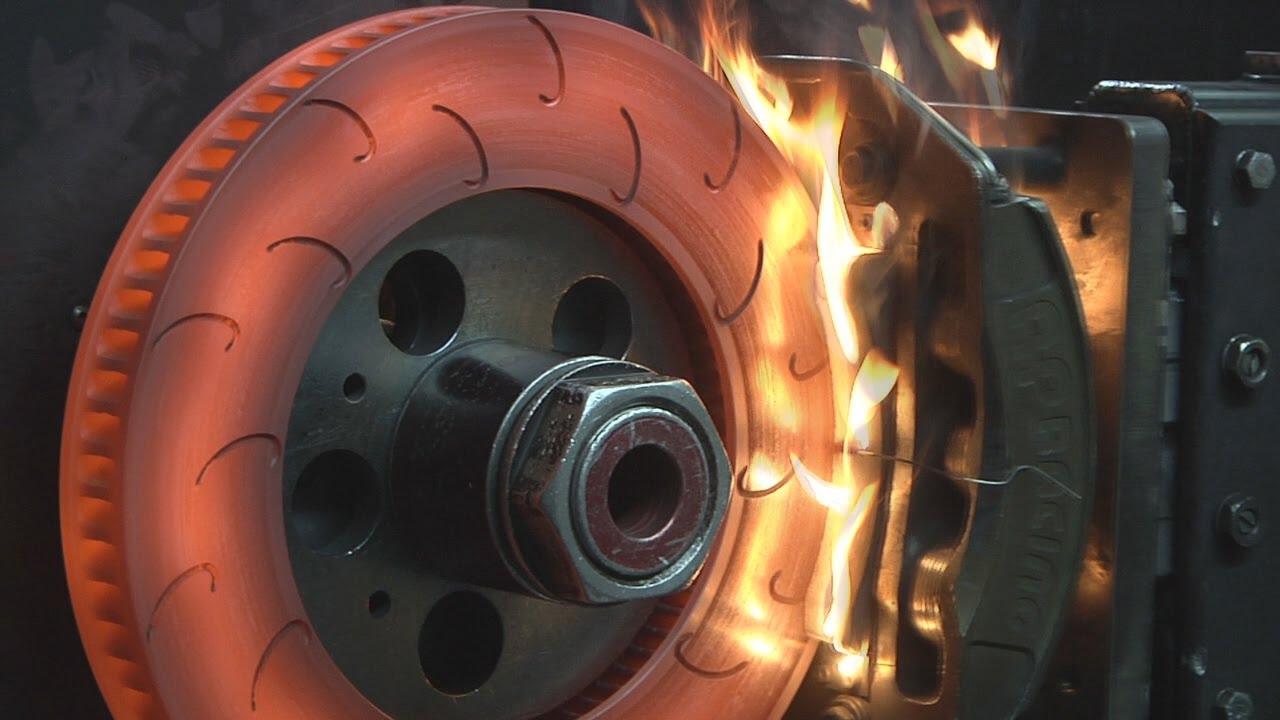
Yes, choosing a sport- or track-oriented pad when you haven't already learned a few lessons the hard way is complicated, even dangerous, because the best sits right next to the worst.

Brake pads have always generated a lot of discussion across the various media, and even at track days. There are as many right answers as there are uses, cars and drivers…
So this little article isn't meant to lay down the law, just to simplify things and guide beginners in their choice without giving them a headache, as experienced drivers generally have enough experience to sort it out for themselves.
The advice below is ordered from the softest use up to the highest level of performance (and price generally goes up accordingly).
Entry level, or clubsport pads
Let's talk a bit about Ferodo's DS2500 .
A very well-known and well-respected reference, and despite fierce competition in this part of the market, it's a pad that remains firmly established.
This pad is aimed at sporty driving, not all-out performance. It's an improved OE-type version, so it offers progress in every area without being revolutionary either. It can be used to discover the track, but with the limit of very heavy braking (e.g. 220 to 100 km/h), which could literally turn it to dust.
If you're already a fairly seasoned track driver and want to discover the track with your new toy, this isn't the right candidate! They'll be punished by hard braking or by sessions longer than a beginner's.
If you're more into regularity or navigation rallies, driving on mountain roads for example, it's a better fit. You can genuinely call it Clubsport
Illustrated with the Ferodo range:

In extreme conditions, the DS2500 or the DS Performance will melt away completely (hence a short life). That shows they're mostly designed to work cold, so their performance in extreme conditions is inversely proportional to their performance in everyday use. You can do track days with DS2500s, but don't use Uncle Jean-Paul, who's been racing his GT4 for 20 years, as your benchmark... you'll need to brake earlier, limit the hard initial phase and stretch out your trail braking (if you don't understand that sentence: it means you should start with some coaching! :-) ...)
Discovering track driving:
If you're keen to get into circuit driving, or you drive at a fast pace on demanding roads (mountains, for example), or you fancy a go at the Nordschleife, the DS3000, which sits above the DS2500 in the range, has a much higher temperature tolerance, so it will cope with more intensive use. But its progressive friction coefficient also lets it work well from low temperatures, without being aggressive on the discs in everyday use. Of course there are other pads with this profile, but few brands offer the availability of Ferodo, which is the main reason for choosing this reference.
The alternative you might be offered is the DSUno, a more premium pad that's better than the DS3000 in almost every respect, but over the same temperature range, for a slightly higher price.
This Ferodo chart shows the temperature ranges clearly:

You might think "I'll take DS3.12s, I'll be fine, they'll stop", well, no... when your technique isn't good you don't hit the brakes hard enough, so in the end the pads aren't in their optimal operating range, you don't scrub off enough speed, you hold heavy braking for too long, and that's when you overheat them... the result won't be pretty. That's why DSUnos are interesting and a good stepping stone; if you're being coached (a real coach or a very experienced friend), you can move on to the next stage.
Regular track driving:
At this stage you're hooked, you want to drive… the car starts to evolve because drivers who are still starting out are often held back by a lack of braking power from the stock system.
At first you brake too hard, too early, without enough trail braking, which thermally saturates the brake system, so you quickly experience "the pedal to the floor" and the lonely moment that follows! Decision made: never again…
Brake lines and high-temperature brake fluid soon follow, and at the very least a choice of better-suited pads, or even a big brake kit.
This is the area of use where the choice is overwhelming, the cars very different, and you quickly get lost.
To keep it simple, it makes sense to go for a pad designed for potentially heavy cars doing endurance, because there are plenty of costs in this early phase, often with quite a few essential upgrades (tyres, set of wheels, suspension, brakes…). You're a long way from setting blistering lap times, so the competition pad with a bite that would almost rip off the front axle isn't on the agenda (especially as that one… it'll chew through discs at top speed, melt away quickly, and it's pretty expensive).
For everyone who's starting to upgrade properly and drive regularly, our advice is the Pagid RSL29. It has proven itself, it's reasonably priced, and it lasts … and lasts… and lasts!
But very high-performance pads can come with a few small constraints: bedding-in has to be done perfectly, squealing if you don't cool them properly on track, dust, and less-than-optimal cold braking (careful: cold, an RSL29 is at the level of a DS2500…. which is fine, but compared with the feel when hot, it feels like it doesn't brake).
As an alternative, we could suggest the DS UNO, which works well once warm, or PFC08s if available in the right shape.
Pagid RSL range:

Off the bat, you might be tempted to take the RSL1, about 20% more friction, but more friction at the pad = more wear on the brake disc. The RSL is mainly appreciated because it's consistent over a very wide temperature range, and as an endurance pad it makes up for its mid-range cost with much greater durability than so-called "sprint" pads.
The track-rat variant:
He's a lost cause and has mutated all the way: SP98 has replaced his blood, his arms are rose-jointed and his eyes are made of Makrolon! So his ride doesn't even need discussing, almost nothing stock left, from clubsport+++ that still comes on the road to a dedicated trailer car whose interior looks like a squirrel cage.
He's been driving for a few years, sometimes 10 to 12 days a year. What he needs is lap time, bite, a clean trail-braking feel, but still an honest price/performance ratio.
For this more intensive, more aggressive but controlled use, we've selected not 1 but several options:
The PFC 11: its bite gives an initial brake attack that lets you brake stress-free at the Dijon Prenois footbridge or before Les Combes at Spa at over 250 km/h, with some margin left if you need to out-brake your mate (any resemblance to real situations / drivers is purely… intentional! They'll know who they are). What's more, thanks to its feel, you can control your trail braking without that sometimes spongy feeling at the end of braking.
You can pair it at the rear with PFC 11 or PFC 08, depending on whether or not you want the rear end to be mobile on turn-in.
The Endless ME20 is Endless's compound for short races and entry-level endurance formats. It's a product genuinely designed for competition, with all the endurance and temperature-resistance qualities that implies. Its friction coefficient is lower than PFC11, but its qualities mean the brake attack is no worse, and if you have fairly expensive discs, they'll spare them a bit more.
As an alternative, we could suggest MA45Bs, which are known for their endurance (used by many Porsche endurance teams) and for preserving discs, but at a high price.
PFC range:

The strangest curve is the PFC 11's. In plain language it would be "the harder you hit it, the harder it brakes". In short, you can go for it. This kind of profile means you always have brakes and reserve, because when you've been driving for a long time your safety margins shrink. You need 200% confidence in your equipment to react the right way, without having to listen to whether your car is responding properly.
Conclusion:
Depending on the situation, the needs, the demands, the grip, the car and its setup, there are more than twenty pad compounds that can be offered beyond these few fairly "generic" references, so don't hesitate to ask us. If we don't know the answer, we've surrounded ourselves with the right people ;-)
Share: