


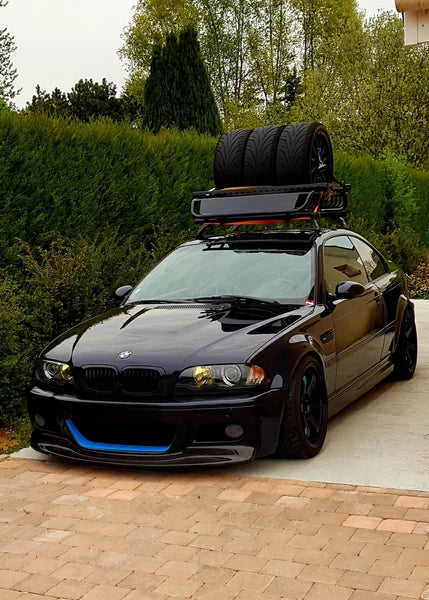
Among the questions we get asked most often in the Team, tyres come up a lot.
What pressures? Will I wear them out a lot? Is it better to go for a brand name or for Chinese tyres?
We'll try to answer the main questions in this article.
This article is updated regularly. It will mainly interest beginners, but there's some information that may interest even the most seasoned wolves.
We don't know it all; we're sharing our hands-on experience.
Quality tyres or Chinese tyres?
Tyres are what connect your car to the road (thanks, Einstein). They're an essential safety component, just like the seatbelt or the airbag. There's only one possible answer for us: you need quality tyres.
Quality tyres are progressive, which brings safety and confidence to your trackday. They're reassuring because they're more predictable and give more warning. That way you avoid scaring yourself, and you learn all the better how to tame your car's different behaviours.
So to sum up, tyres bring safety, and therefore confidence, and those are the 2 conditions you need to progress, because progress inevitably means taking risks progressively.
There's a wide range of tyres, from classic road tyres to sporty road tyres, through hypersport, semi-slicks and finally slicks.
Road tyres, semi-slicks or slicks?
It all depends on how the car is used and how often it goes on track, but also on the driver's level.
Road tyres are enough to get started and protect you against the risk of rain. You need to choose a quality brand to avoid scaring yourself, as mentioned above. In this range we'd mention the PS4S or the Continental SportContact 7.
There's one category that generates a lot of discussion on forums and other groups: what we call Hypersport. No longer pure road tyres, but not yet semi-slicks. It's still an in-between, a compromise, but it's clearly the last step if you want to drive to the track on the road and back. These are Michelin Cup 2s, Federal 595 RSs (among the most affordable), Nankang NS-2Rs or Yokohama AD09s.
The semi-slick is a good compromise. It lets you drive there on the road (if there are no heavy showers and it isn't too worn = careful, the window is narrow) and delivers good performance on track. In the rain it gets tricky, and warming it up can be difficult if you can't build up enough pace. The ones we like: Yoko A052, Goodyear Supersport RS, Nankang AR1, Direzza 03G, Pirelli Trofeo R.
Slicks are banned on public roads, so they'll only concern a minority of enthusiasts who have either a dedicated track car, a trailer, or mates following in "support" mode with the slicks in the boot.
Second-hand they're affordable, but the quality can be hit and miss; new, it's €500 to €600 per tyre, and running slicks means knowing how to manage pressures and warm-ups. We advise against skipping steps by going straight to slicks. You should at least already have a feel for the grip limits of a hypersport tyre before considering moving up to this category. Cold, they have almost no grip at all; the grip comes as the tyre gradually warms up.
If you're not afraid of what others think while you drive a neon-yellow Turkish delight with a wing big enough to pay property tax on in Paris, there's a solution we like in the Team:
The Rakapneu


What pressures should I run?
On this subject, everyone has their own interpretation. It has to be said that it also depends on the type of tyre, its quality and the driver's ability to heat them up to get them into their performance window.
Most track-oriented tyres (semi-slicks and slicks) give their best performance between 2.0 and 2.2 bar hot.
You'll need to adapt the starting pressure to the weather conditions on the day (cold, rain, blazing sun…). This needs to be done regularly throughout the day, so several times, as the track can change radically.
For more modern cars with pressure sensors on the on-board computer, a quick glance and you're done, even if the accuracy can sometimes be rather hit and miss. Either way, nothing beats the good old gauge you plug in between sessions: for this, we recommend a karting gauge. The €30 one from Sudauto or Feu Vert can end up with a destroyed tyre (been there!).
Running pressures that are too low means risking damage to the tyre carcass and therefore potentially putting yourself in danger. So be especially careful after long breaks, particularly when going back out after lunch.
Generally speaking: don't go out below 1.9 bar cold, do 3 laps, lower the pressure, go back out. At some point it stabilises at the desired pressure!
There are many configurations depending on use, but also on the vehicle's weight, which can affect tyre choice and performance.
Don't hesitate to ask the team, or simply look at the recommendation in your door jamb as a starting point. On Porsches, for example, the pressure shown is valid whatever the use.
Don't forget that optimal grip needs pressure + temperature… don't head out like a lumberjack just because the pressure is OK: as long as the pressure is rising and needs adjusting = the tyre is NOT up to temperature!
And at the end of the day, remember to add pressure even if you're at 2.2: when you head back out on the road, the tyres will cool and the pressure will drop. Add 0.5 more. Same if you're putting it back on the trailer: cold, the tyre will drop to 1.3 - 1.5 bar and could damage the carcass, especially if it goes into storage right after.
To head home with peace of mind, we recommend this kind of small inflator (from your favourite brand, so you can share the battery with your impact wrench, for example):

And what about wear?
They're bound to wear, but sometimes it's because of a bad choice, sometimes a technical reason, sometimes unsuitable geometry, and sometimes it's simply the driver's technique, over-driving and putting them through agony.
A bad choice is, for example, a tyre that's too soft on a car that eats tyres: R888s on a Mégane RS can end up down to the cords in less than a day.
The technical problem can be external to the tyre, like dead dampers, but also specific to the tyre, with pressure that's too low and makes them overheat: it grips for a while, then overheats …. it slides… it melts like snow in the sun.
Unsuitable geometry, with insufficient camber, won't let the tyre work flat under load, but on its shoulder instead. A classic issue we're used to dealing with.

As for driving technique, only repetition and coaching will teach you the basics.
Depending on all these variables, a tyre may last only half a day, but conversely it can last 6 to 8 days. As a general rule on track, it's the fronts that take a beating… and just because you have a rear-wheel-drive car doesn't mean the fronts will be spared.

And finally... Our "don't like" top list
AD08RS, Zestino, Nankang CRS, tyres with a DOT production date more than 2 years old, Federal 595 RS-Pro, Toyo R888, Cup 2 R (ultra-fast wear), etc…
Share: