



It's the scenario everyone knows from trackdays: the first laps are good, the times are dropping, then the car starts running out of breath. Temperatures rise, power gradually fades, and sometimes safe mode kicks in. The usual reflex when faced with overheating is to change the coolant or fit a bigger water radiator. It's often a misdiagnosis. Here's how the S55's thermal management really works, and why it has to be treated as a whole or not at all.
The S55 is first and foremost a heat exchanger
You need to see the S55 for what it is: a huge heat exchanger. Its air-to-water intercooler system was a genuine breakthrough when it came out, and BMW clearly got it right, since this architecture remains the basis of its current high-performance engines, B58 and S58 included.
This design gives the engine its performance, but it also imposes a logic: nothing is independent. Four flows constantly interact — oil, water, charge air and exhaust gases (EGT). Changing just one of these circuits without considering the others moves the problem rather than solving it.
The most widespread error of reasoning
When people talk about cooling, the first reflex is to think of the water circuit. It's the reasoning that costs S55 owners the most, and it rests on two separate misconceptions.
First misconception: believing it's the water that cools the engine
The mechanical reality is this: oil provides about 80% of the engine's heat dissipation. Water only stabilises. It maintains an operating temperature; it doesn't remove the bulk of the heat.
In practical terms, this means that investing only in the water circuit while neglecting the oil amounts to dealing with 20% of the problem. It's also why the choice of oil and how often it's changed matter so much on an S55 used on track, and why an uprated oil cooler is one of the logical upgrades in a serious build.
Second misconception: mixing up the two water circuits
This is the one that makes people spend money in the wrong place. On an S55, there are two separate water circuits, which do completely different jobs:
- The engine water circuit supports and complements the oil. It's a matter of the engine's overall reliability.
- The intercooler circuit cools the charge air. It's directly a matter of performance — whether it stays consistent or fades lap after lap.
The error lies precisely in lumping these two systems together. An owner who loses power at the end of a session and invests in the engine water circuit won't fix anything: the problem is on the intercooler side. Conversely, an engine whose oil temperature climbs on track won't be saved by a better intercooler.
The right reflex: first identify what you're trying to solve. Gradual loss of performance and reliability concerns aren't fixed with the same parts.
The real thresholds of the stock system
The OEM system isn't bad; it's sized for a given use. Here are the limits we see in practice:
- Stock heat exchanger: limit around 630-650 hp
- Stock radiator: limit around 550-560 hp
These figures deserve a careful reading. The radiator saturates before the heat exchanger, which explains why so many builds that are well thought out on the intake side still end up in thermal trouble.
On track, these thresholds collapse
This is the point spec sheets never mention. The values above correspond to normal use. The track is the most unfavourable condition there is: it exhausts the system's dissipation capacity, because temperatures stabilise high and the engine never gets a chance to come back down.
To go back to the heat exchanger example: a threshold of 630-650 hp on the road becomes more like 560-580 hp on track. That's not a nuance; it's around sixty horsepower of margin that disappears.
In concrete terms: a car that holds its temperatures perfectly on the road can overheat after three laps on track, at exactly the same power. It's not the power that has changed; it's the system's ability to get rid of what that power produces.
The practical rule: beyond 500 hp, or as soon as track use becomes regular, upgrading the cooling system is no longer an optimisation option. It's a prerequisite.
What overheating actually damages
Overheating isn't just a one-off loss of performance. It leaves its mark.
- It degrades plastics. The engine bay contains a lot of them, and they age badly under repeated thermal stress.
- It raises IATs (Intake Air Temperature). The hotter the intake air, the less dense it is, and the less power there is. And the ECU pulls timing to protect itself.
- It accelerates wear on everything else. Every component works in degraded conditions.
It's a classic vicious circle: heat raises IATs, IATs cost power, you push harder to compensate, and the heat rises further.
The scenario nobody wants to go through
There's an outcome far more serious than a loss of performance, and it's directly linked to the S55's air-to-water architecture.
Over time, persistently high IATs lead to heat exchanger failure. And in an air-to-water system, the heat exchanger circulates coolant in contact with the intake air. When it fails, that coolant can get into the engine.
If the amount is small, you get away with it. If it's large, the liquid doesn't compress: that's engine failure, for good.
That's why we insist so much on this subject. Neglecting the thermal side of a tuned S55 doesn't cost you a few tenths on the clock. It can cost you the engine.
The DO88 Big Pack: what it changes
This is the solution we recommend to deal with the whole charge air cooling chain, rather than improving one isolated link.
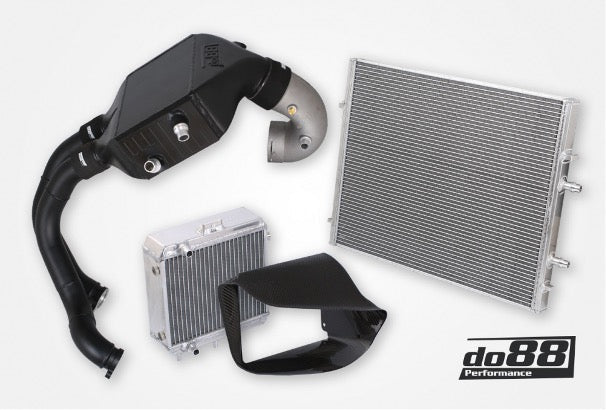
The pack includes:
- A high-performance intercooler, replacing the stock heat exchanger
- The intercooler radiators, sized accordingly
- Reinforced hoses, replacing the stock parts that are sensitive to pressure and heat
- A radiator scoop, to improve the fresh air supply
The measurable result: a gain of around thirty degrees in IAT on a properly sized setup. That's not a marginal improvement. It's the difference between a car that loses its power after three laps and a car that lasts its entire session.
The value of the pack lies in its consistency. Fitting a better intercooler without the matching radiators simply moves the bottleneck. The scoop, often overlooked, determines how effective everything behind it really is.
Where to start if you're doing it step by step
Not everyone has the budget to do it all at once. We also sell the components individually, which lets you spread it out. In that case, the order matters.
- 1. The intercooler radiators. They're the link that saturates first. Starting there gives the most immediate gain.
- 2. The intercooler. Once the radiators are up to scratch, it becomes the new limiting factor.
- 3. The scoop. It makes the most of everything fitted before it, at a modest cost.
- 4. The reinforced hoses. To be done preventively, before a stock part gives way.
One thing to note: if you know you'll do the whole lot eventually, the pack works out cheaper than buying the parts separately, and you only pay for one fitting job.
The two parts to deal with preventively
Two components are directly exposed to thermal and pressure stress, and our position is unambiguous: the stock charge pipes and J-Pipe will break eventually. It's not a question of if, but when.
On a stock car used on the road, that day is a long way off. On a tuned car that sees the track, it comes round quickly. A charge pipe failure mid-session is at best a wasted day, at worst a trailer ride home.
These parts are inexpensive compared with what they prevent. They're part of the same cooling job and are naturally dealt with at the same time.
Our approach
Overheating on an S55 isn't fixed part by part according to whatever failed last. It has to be thought of as a system, with a power target and a use clearly defined up front.
We sell the parts and point you to a workshop in our partner network if you don't have a go-to tuner. On this kind of job, the quality of the fitting — sealing, hose routing, proper air feed to the scoop — directly determines the real gain.
Not sure what your setup really needs? Tell us your tuning level and how you use the car, and we'll tell you where to start.
This article is part of our complete guide to making the BMW S55 engine reliable.
Sources: workshop feedback from Team Lupos and our network of partner tuners, DO88 technical data.
Share: